
Reducing Emissions Through Energy-Efficient Homeworking
Reducing Emissions Through Energy-Efficient Homeworking
9 April 2026
Flexible working, with employees either working fully remotely or splitting their time between the office and home, is now commonplace in the UK (Clark, 2026). At the same time, many organisations are taking steps to understand and reduce their environmental impact, whether due to stakeholder demand, regulatory pressure, cost-saving opportunities, or a desire to be a responsible corporate citizen.
For these companies, having a flexible working model poses important questions: How do remote and hybrid working models fit with our sustainability agenda? How can we monitor our company’s environmental impact if some of that impact occurs in our employees’ homes? How do we calculate emissions from homeworking?
Aligning your flexible working model to your sustainability agenda can help your organisation meet its ESG commitments, lower indirect emissions, while also helping save employees money on household energy bills.
WHAT SUSTAINABLE HOMEWORKING MEANS - AND WHY IT MATTERS
Sustainable homeworking isn’t just switching off lights or powering down devices.
At its core, it’s about encouraging energy efficient behaviour and reducing the environmental impact of employees’ work from home routines.
This can involve providing resources and equipment to make it easier for employees to minimise emissions when working from home, as well as encouraging sustainable practices and idea-sharing. Over time, these small changes add up, benefiting both people and the planet while strengthening your organisation’s environmental credentials.
HOMEWORKING AND SCOPE 3 EMISSIONS
The Greenhouse Gas Protocol, which provides the most widely recognised accounting standards for greenhouse gas (GHG) emissions, categorises GHG emissions into three ‘scopes’, with homeworking emissions classed as Scope 3.
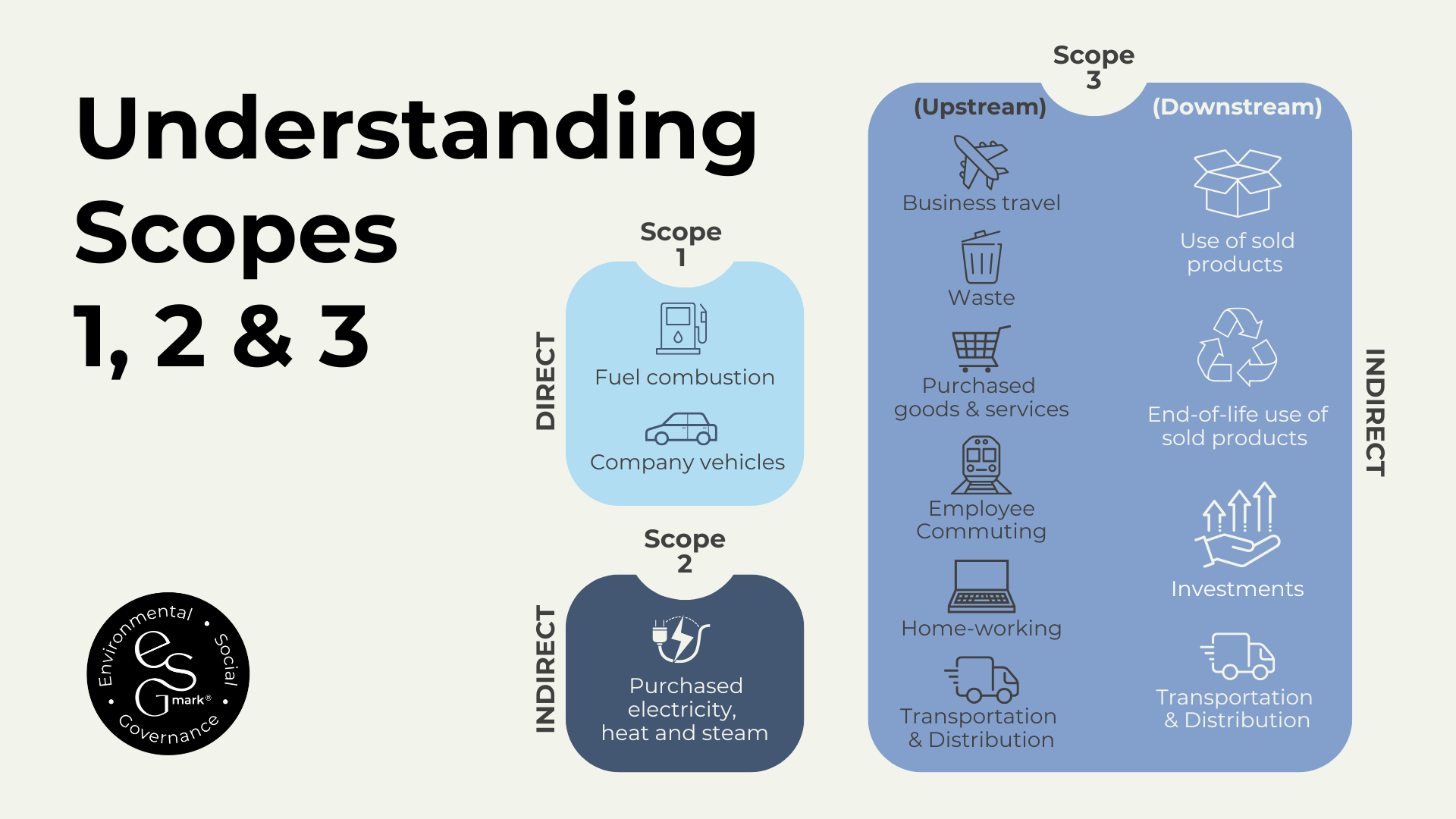
To learn more about scopes 1, 2, and 3 and how your organisation can measure its carbon footprint, head to our explainer here.
Home working emissions primarily arise from domestic electricity and gas use during working hours. Heating and air conditioning tend to dominate homeworking emissions. Lighting and online activities such as video calls, cloud storage, and using computer equipment all contribute, though in smaller amounts. While each individual employee’s impact is usually relatively small, understanding them gives businesses a clearer picture of their carbon footprint and how to reduce it without compromising productivity. It’s also worth remembering that while an increased proportion of home working time can raise associated emissions, it also usually reduces commuting-related emissions for a business.
As a result, many organisations now include homeworking emissions in their carbon reporting to better understand their total footprint. This both aligns with ESG best practice and highlights opportunities to reduce energy use, lower costs, and support employees in making sustainable choices.
MEASURING YOUR HOMEWORKING CARBON FOOTPRINT
Measuring emissions from homeworking doesn’t need to be complicated. Simple employee questionnaires can provide insights into:
How many hours and days employees work remotely
The type of devices they use
Heating and energy use at home
Energy-saving habits
Greener energy choices
This information feeds into Scope 3 carbon footprint assessments and helps you to identify opportunities to reduce your organisation’s carbon footprint. When carrying out your own research, keep questionnaires short, easy to complete and transparent, and reassure your employees that responses are anonymous as this encourages more accurate reporting.
PRACTICAL WAYS TO ENCOURAGE ENERGY EFFICIENT HOMEWORKING
While you obviously can’t directly control your employees’ household energy usage, you can support your employees in working more sustainably:
Provide efficient IT equipment: provide laptops or refurbished devices with power saving settings and ensure they’re responsibly recycled at the end of their life.
Avoid equipment duplication: minimise using energy intensive equipment at home that’s already available in the office.
Promote digital mindfulness: encourage employees to reduce making unnecessary video calls, sending large email attachments, or duplicating documents.
Give energy efficiency guidance: Share information and tips on sustainable practices through workshops or internal platforms. For example, this can include only heating the areas in use rather than the whole house, swapping all bulbs to LEDs, using smart programming such as automated lighting, and heating, and switching off devices when not in use.
Suggest renewable electricity: where possible, encourage employees to consider and switch to renewable energy tariffs.
Signpost employees to resources such as carbon footprint calculation tools, e-waste recycling points, or grant schemes for improving residential energy-efficiency (such as the UK Boiler Upgrade Scheme).
Encourage idea-sharing and celebrate examples of sustainability, such as by offering rewards for behaviours that improve environmental impact.
Provide financial incentives, such as subsidising energy-efficient home energy bills for employees who use or switch to renewable tariffs.
These actions may seem small, but across your entire workforce they soon add up and can significantly reduce your organisation’s homeworking emissions.
EMBEDDING SUSTAINABLE PRACTICES THROUGH POLICY
Sustainable homeworking is most achievable when it is part of your remote and hybrid working policies. Clear guidance and practical advice in your policies can help employees make energy efficient choices while maintaining the flexibility that hybrid working offers.
For more detailed guidance, the ESGmark® Remote and Hybrid Working policy guide offers practical tips and advice for businesses.
START SMALL AND MAKE A BIG DIFFERENCE
Supporting sustainable homeworking offers opportunities for businesses today to improve the environmental impact of their operations and bring their employees along on their ESG journey. By combining practical guidance, simple measurement tools, and supportive policies, your organisation can empower employees to work more efficiently from home, reduce home working’s carbon footprint, and provide a measurable commitment to sustainability.
Even small changes, such as switching off unused devices or encouraging digital efficiency, can make a meaningful difference. Our advice? Start small, focus action on those areas that have the biggest impact, and begin to build a culture of sustainable working practices that benefits everyone.
HOW ESGMARK® CAN HELP
At ESGmark®, we specialise in helping organisations navigate their sustainability journey and measure their carbon footprint. Our expert team helps you collect and understand your data, comply with regulations, communicate effectively with stakeholders, and most importantly, drive real-world impact with an emissions reduction plan that benefits your business. Our process is collaborative and adaptable; tailored to fit around your business, not the other way round.
To learn more about our carbon footprint service, visit our page here. If you have any questions or would like to book an introductory call to discuss your project, please contact us.
Sources:
Clark, D. (2026) Share of people working remotely, hybrid working, or at work in Great Britain from May 2020 to March 2026. Statista. Available at: https://www.statista.com/statistics/1207746/coronavirus-working-location-trends-britain/
Greenhouse Gas Protocol (n.d.). Scope 3 Calculation Guidance. [online] ghgprotocol.org. Available at: https://ghgprotocol.org/scope-3-calculation-guidance-2.