
Natural Burials: Sustainable Memorials and Soil Health
Natural Burials: Sustainable Memorials and Soil Health
July 2026
When we lose someone we love, most of us aren't thinking about soil chemistry or ecosystem health. We're thinking about how to honour their memory in a way that feels meaningful to them and us, whether that's scattering their ashes in a favourite place, planting a tree in their memory, or choosing another form of burial.
However, as our understanding of environmental systems grows, so too does our understanding of how these different memorial choices interact with the natural world. This creates an opportunity to explore new approaches that support both meaningful remembrance and long-term ecological health.
One organisation helping to address these challenges is Natural Transition, which provides a sustainable, scientifically proven soil blend for cremated remains, making a safe return to nature possible. Natural Transition achieved ESGmark® re-Certification in 2026, an important milestone that demonstrates the company's continued commitment to high standards in Environmental, Social and Governance (ESG) practices.
In our guest blog, The truth about ashes, Claire Lyons, Consultant with Natural Transition, explores the environmental impact of cremated remains and their often-overlooked effects on soil, water, and plant systems. This article builds on that discussion by examining how changing awareness, funeral practices, and innovative memorial solutions are contributing to the rise of eco-friendly funerals and more nature-focused forms of remembrance across the UK.
THE RISE OF NATURAL BURIALS AND LIVING MEMORIALS IN THE UK
Demand for nature-based memorial choices is rising steadily. Cremation now accounts for approximately 78-79% of funerals (Cremation Society of the United Kingdom, 2025), meaning large volumes of cremated remains are being returned to soil and natural environments each year.
One of the key drivers behind this shift is cost. The SunLife Cost of Dying Report 2026 (SunLife, 2026) reports that the average traditional burial now exceeds £5,000, reinforcing interest in more accessible options such as cremation. The report indicates that scattering the ashes of loved ones in gardens of remembrance is most common – a trend also shown by the continued expansion of natural burial UK provision and woodland burial sites across the UK (APSE, 2025). These trends reflect increased institutional support and personal demand for nature-based memorial alternatives.
Alongside cost considerations, there is a wider cultural shift in how people approach remembrance. The increasing use of natural burial sites, woodland cemeteries, and garden-based memorials as alternatives to conventional burial or scattering ashes reflects the values of green funerals, where environmental responsibility, simplicity, and connection to nature are central. Through these nature-based practices, memorials are part of living systems that evolve over time.
THE ENVIRONMENTAL IMPACT OF CREMATED REMAINS ON SOIL AND ECOSYSTEMS
For many people, scattering ashes beneath a favourite tree, in a garden, or somewhere meaningful feels like a natural way to honour a loved one. But what many people don't realise is that cremated remains behave differently in the environment than most of us realise. Until recently, very little information was available about how cremated remains affect soil and plant health over time.
Despite being commonly referred to as “ashes”, they’re not ash in the conventional sense but sterilised, finely processed bone fragments; more comparable to fossil. Because of this composition, they don't break down in soil in the way most people assume.
As cremated remains have a high pH and elevated sodium content, when introduced into soil, especially in concentrated amounts, they can alter the soil chemistry, affecting nutrient availability, microbial activity, and how well plants grow. These effects become more pronounced when moisture is present, allowing salts and minerals to disperse through surrounding soil layers rather than remaining contained.
Cremated remains are often scattered in gardens, woodlands, or around trees as a symbolic form of remembrance because they symbolise life, growth, and continuity. An unknowing and unfortunate outcome can be that when a memorial tree or planting fails to thrive, it can feel like a second loss for families. This highlights why soil health is not just an environmental consideration, but an important part of creating lasting memorials.
NATURAL TRANSITION: MAKING A SUSTAINABLE RETURN TO NATURE POSSIBLE
In response to these challenges, a more holistic approach has been developed.
Working with crematoriums and other end-of-life partners, Natural Transition supplies the only organic mixture that has been specifically created as a re-balancing approach that supports soil and plant health as well as the lasting memorials families hope to create.
Don't confuse lowering the soil pH to lowering the pH of the cremation ash. There are many ways to lower the soil pH quickly, but it takes time to lower the pH of cremation ash.
A team of multi-disciplinary experts have worked over several years to create something that not only helps soil to manage the harmful chemical elements of cremation remains, but can also work directly on the cremation ashes to help release the beneficial elements they contain.
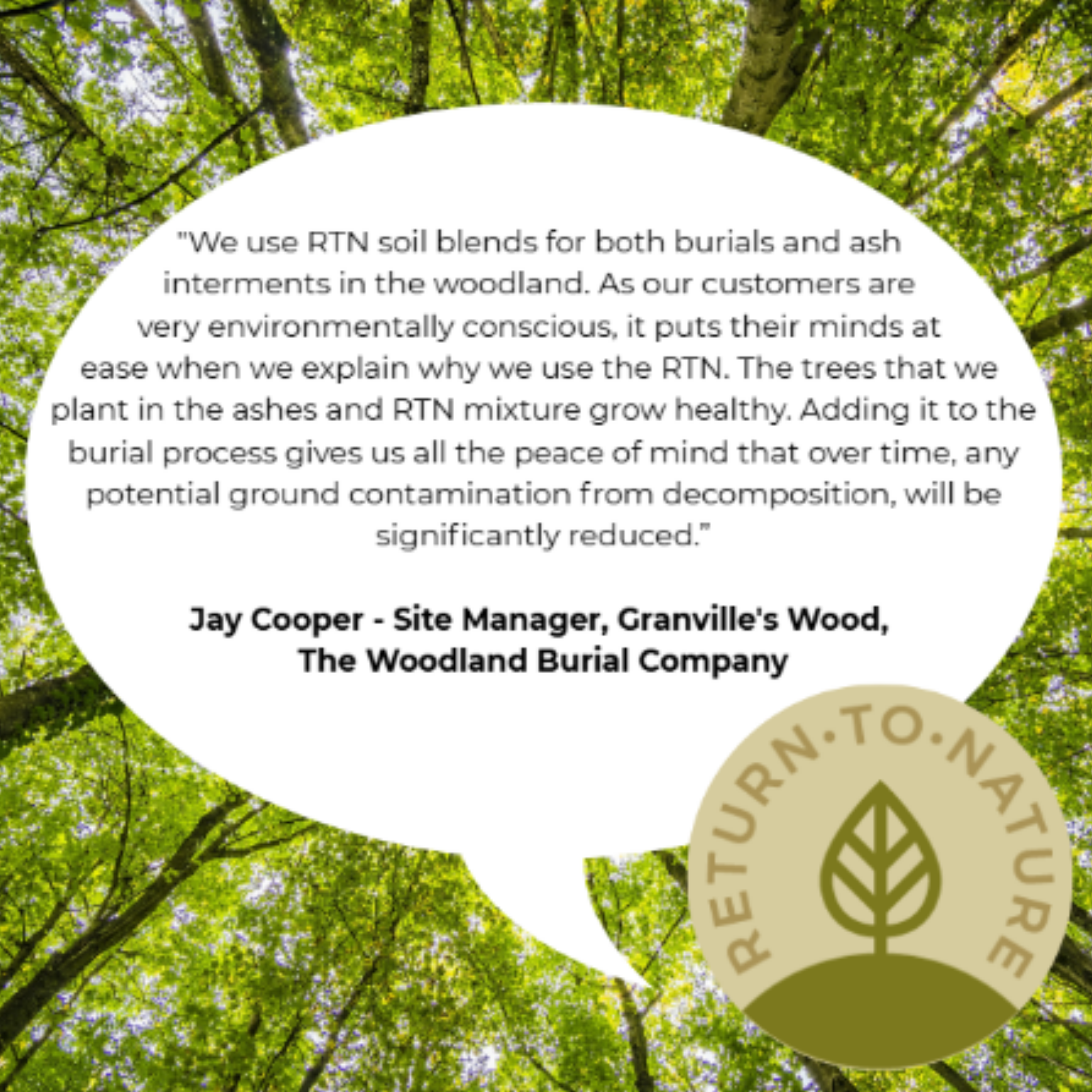
RTN Soil is a 100% organic soil amendment designed to help rebalance the high alkalinity and sodium levels found in cremated remains, while supporting soil health and microbial activity.
“Cremation ashes are highly alkaline and contain salts that damage soil and prevent plant growth. However, when treated with RTN Soil, they can be safely used to grow trees and plants, helping to ensure that hundreds of living memorial trees and plants will flourish in years to come,” explains Katee Holden, Director at Natural Transition
By supporting the longevity of living memorials, RTN Soil supports ecosystem balance while reducing the cost of replacing memorial plants – an issue that many crematoriums and families otherwise face. This is valuable for councils, crematoriums and families, who are increasingly considering how memorial practices sit alongside environmental concerns and affordability (APSE, 2025; SunLife, 2026).
THE FUTURE OF ECO-FRIENDLY FUNERALS AND SUSTAINABLE MEMORIALS
With cremation remaining the most common funeral practice in the UK, more attention is turning to how its environmental impacts are understood and managed, and a more Natural Transition is emerging. This is leading to approaches such as RTN Soil, which supports natural burials that work in balance with the ecosystems where loved ones are laid to rest, gently nourishing memorial plants and helping sustain living memory over time.
Sources
APSE (2025) State of the Market: Cemeteries and Crematoria 2025 (Briefing 25/38). Available at: https://apse.org.uk/index.cfm/apse/members-area/briefings/2025/25-38-state-of-the-market-on-cemeteries-and-crematoria-2025]
Cremation Society of the United Kingdom (2025) Cremation statistics in the UK. Available at: https://www.cremation.org.uk/Annual-statistics-2025
Green Burial Council (n.d.) Environmental considerations of burial and soil interaction. Available at: https://www.greenburialcouncil.org
SunLife (2026) Cost of Dying Report 2026. Available at: https://www.sunlife.co.uk/funeral-costs/